
Free "Great Speaking Ezine"
Enter e-mail address


More info?


  Contact Us

View Cart

Affiliates

Eleven Presentation Skills
Articles for Speakers

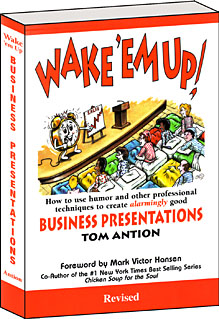
These articles are excerpts from Wake 'em Up Business Presentations by Tom Antion. To order Click Here
For details of book Click Here


Direct comments or questions about these articles to
Tom Antion,
orders@antion.com
Article # 1 Why use humor?
Article # 2 Learn Material Easily Using Bits
Article # 3 In Fun
Article # 4 Timing
Article # 5 Time of Day and Humor
Article # 6 Closings
Article # 7 How to Make a Point with Humor
Article # 8 A Sound, Sound System
Article # 9 To Laugh or Not to Laugh, That is the Question
Article # 10 Transitions
Article # 11 Banquet/Luncheon Tips

To order Books, Audio and Videotapes on these topics
http://www.antion.com/speakershop.htm 

Why use humor?

Tom Antion
Washington, D.C.

Why should I bother using humor in my presentations? Can't I just
deliver my information and sit down? You sure can and that's what
most people do. The problem is that most people are not effective
presenters. They are nighty nite, snooze inducing, say your
prayers, hit the sack, unlicensed hypnotists. They are ZZZZZs
presenters. They might be experts in their field and be able to
recite hours and hours of information on their topic, but is that
effective?

According to Bob Orben, Special Assistant to President Gerald
Ford and Former Director of the White House Speech writing
Department, "Business executives and political leaders have
embraced humor because humor works. Humor has gone from being an
admirable part of a leader's character to a mandatory one."

A survey of top executives who earned more than $250,000 per year
was conducted by a large executive search firm. The survey found
that these executives believed their communication skills were
the number one factor that carried them to the top. Mastering
the use of humor and other high-explosion techniques puts a fine
polish on your presentation skills which can help propel you to
the top of the speaking profession.

There are many benefits you can derive from using humor in your
presentations. Keep in mind that these benefits only help you
reach your ultimate purpose for making the presentation. They are
not purposes themselves unless, of course, you are only
interested in entertaining.

Using humor does the following for you:

HELPS YOU CONNECT WITH THE AUDIENCE.

MAKES YOU MORE LIKEABLE.

AROUSES INTEREST.

KEEPS ATTENTION.

HELPS EMPHASIZE POINTS AND IDEAS.

DISARMS HOSTILITY.

OVERCOMES OVERLY FLATTERING INTRODUCTIONS.

GETS YOUR POINT ACROSS WITHOUT CREATING HOSTILITY.

HELPS RELATE FACTS AND FIGURES.

MAKES A POSITIVE IMPRESSION.

SHOWS THAT YOU DON'T TAKE YOURSELF TOO SERIOUSLY.

HELPS PAINT PICTURES IN THE AUDIENCE'S MIND.

MAKES INFORMATION MORE MEMORABLE.

LIGHTENS UP HEAVY MATERIAL.

TOM'S LIST

YOU WILL BE ASKED BACK.
YOU WILL GET HIGHER EVALUATIONS OR MORE SALES.
YOU WILL MAKE MORE MONEY.
YOU WILL MAKE PEOPLE HAPPY. This is my favorite benefit. I get
great satisfaction from knowing that I have brightened someone
else's life. I had an executive come up to me after one of my
humor seminars and say, "You opened up a whole new world for me."
I almost cried right on the spot. I'll never forget it.

Next issue learn techniques to deliver your talk without notes.

"Wake em Up teaches you to be irresistible as a presenter."
Also, Foreword by: Mark Victor Hansen,
Co-Author of the #1 New York Times Best- selling series, Chicken Soup for
the Soul


Note: This article is part of an eleven part series excerpted from
Tom Antion's new book, Wake em Up: How to Use Humor and Other
Professional Techniques to Create Alarmingly Good Business
Presentations.
Anchor Publishing, 336 page softcover, $24.95 +
$4.00 S&H, (800) 448-6280 x 1 or FAX to (757) 431-2050 To Order Click Here

top of page

Learn Material Easily Using Bits
(AKA Chunks or Series)

Tom Antion
Washington, D.C.

A bit is a section of material that is so related that it makes
it easy for you to memorize. Each point flows naturally from one
to the next so you can deliver the information without notes (if
you know your material).

Until I learned about bits, I never thought I could be a
professional presenter because I'm not great at memorizing long
talks. I discovered that no one memorizes long talks. They have a
mental or written outline consisting of key words that trigger
the individual bit in their minds. Pros use this concept to be
able to deliver long presentations without the use of notes.

Becoming less dependent on notes has several advantages. When you
stand before a group and deliver information without using notes
your credibility automatically rises. The audience thinks, "Wow!
This person really knows the material." Since you won't be tied
to a lectern or forced to hold notes, you can get physically
closer to the audience, or actually enter the audience on
occasion. The closer you are to them, the better you will
connect. When you leave the script at home you can talk naturally
to the audience rather than read to them. You will also be more
confident because you no longer have to worry about your notes
getting lost.

Using bits has another big advantage. We are busy people. It's
tough to find a spare hour or day to practice a full
presentation. Bits can be practiced when you have a few minutes
here and there. You will be more likely to practice your material
(and we all need practice) if you can practice a three or five-minute chunk rather than the whole
presentation.

Next issue learn how to get the audience ready to laugh.

"Tom's materials will cut five years of a speaker's learning
curve."
Cavett Robert, Founder and Chairman Emeritus,
National Speakers Association


Note: This article is part of an eleven part series excerpted from
Tom Antion's new book, Wake em Up: How to Use Humor and Other
Professional Techniques to Create Alarmingly Good Business
Presentations.
Anchor Publishing, 336 page softcover, $24.95 +
$4.00 S&H, (800) 448-6280 x 1 or FAX to (757) 431-2050 To Order Click Here

top of page

In Fun

Tom Antion
Washington, D.C.

Sigmund Freud wrote:
"The most favorable condition for comic pleasure is a
generally happy disposition in which one is in the mood
for laughter. In happy toxic states almost everything
seems comic. We laugh at the expectation of laughing,
at the appearance of one who is presenting the comic
material (sometimes even before he [she] attempts to
make us laugh), and finally, we laugh at the
recollection of having laughed."

This concept has been termed "in fun" by people that study humor.
If you want your audience to laugh, they must be in fun. You, the
speaker, must be in fun. The emcee or program coordinator must be
in fun. The whole program should be designed in fun.

Don't do anything to take them out of in fun. Don't discuss
controversial subjects like religion or politics and don't make
unfriendly comments to audience members. If a problem occurs
which must be dealt with, find an in fun way of doing so. For
instance, if I'm at a presentation and someone asks me who I
voted for I say, "I voted for the USA." That's a cute way to say
that I really don't want to talk about it.

Retired NSA member and one of the greatest humorists of all time
Dr. Charles Jarvis, told me about a friend of his who was an
excellent speaker, but lost his audience when he forced someone
to turn off a tape recorder. He was so nasty about the way he
said it that the in fun audience totally turned against him.

An in fun audience is more critical for the speaker who is there
to entertain, but the concept should be in the back of every
presenter's mind. Your material may be controversial by nature,
but that doesn't mean that you should go out of your way to do or
say things that will take the audience further out of in fun.

Also, pay close attention to the total program. One friend of
mine had to present comical material just after a passionate plea
went out to the audience to collect funds for starving babies. He
came on stage just after the teary eyed audience had seen slides
of emaciated children. If you ever get caught in this situation,
DON'T start right in with your humorous material. Start out
gently with a sincere reference to what the audience has just
seen. Cut most of your early humor and get to your subject to
ease the audience's transition to your more lighthearted topic.

How do you put in fun into practice? One time I had a
ventriloquist introduce me at an early morning meeting to wake up
everyone and get them in fun. You could pass out fun snacks to
the audience or put balloons on their chairs. Meeting
announcements and agendas can be decorated with cartoon
characters. Funny props are great for putting people in fun. Do
anything you can to be sure your audience knows that it's OK to
laugh.

Next issue learn the techniques of good timing.

"At Hawaiian Tropic we believe that fun and excitement keep our
corporate staff and distributors productive. Tom can teach you
how to create this excitement every time you address a group."
Ron Rice, Owner and Founder,
Hawaiian Tropic/Tanning Research Labs., Inc.


Note: This article is part of an eleven part series excerpted from
Tom Antion's new book, Wake em Up: How to Use Humor and Other
Professional Techniques to Create Alarmingly Good Business
Presentations.
Anchor Publishing, 336 page softcover, $24.95 +
$4.00 S&H, (800) 448-6280 x 1 or FAX to (757) 431-2050 To Order Click Here

top of page

Timing

Tom Antion
Washington, D.C.

Timing is one of the most important aspects of humor and NO
ZZZZZs presenting. Not only is timing involved in an individual
piece of humor, it is also involved in the placement of that
piece of humor in the overall presentation. Timing is also
involved in spontaneous reactions to "expected" unexpected
developments during the presentation.

Jack Benny said, "Timing is not so much knowing when to speak,
but knowing when to pause." He should know, because he delivered
one of the funniest and most famous lines in the history of
comedy after an extremely long pause. He was being held up by a
robber at gunpoint. The robber said, "Your money or your life!"
Jack didn't say a word for an extended period of time. The robber
became impatient and said, "YOUR MONEY OR YOUR LIFE!!" Jack
finally replied, "I'm thinking." His persona as a cheapskate,
coupled with a long pause indicating he was having trouble
deciding whether to give up his money, or die was hilarious. A
pause lets the audience catch up and draw pictures in their mind.
It is the audience's signal to imagine.

In joke telling, a pause just before and just after your punch
line gives the audience a chance to laugh. Absolutely do not
continue to talk when laughter is expected. Laughter is hard to
get and easy to discourage. Hold eye contact a little bit longer
than you think you should when delivering punch lines because
time is hard to judge when you are pumped-up for a presentation.

The size of your audience will affect your timing. Your
presentation will take less time to deliver to smaller audiences.
Smaller audiences should mean quicker laughter. Conversely,
presentations will take longer for extremely large crowds. Your
pauses will be longer to compensate for the wave effect created
because of the physical distance between you and the back row of
the audience.

Next issue learn how the time of day effects your audience
response.

"In Wake em Up, Tom Antion teaches us how to get our message
across, do it with humor, and keep the audience awake all at the
same time. That's great, although I've learned through experience
that when I'm not doing 1 and 2, I prefer that the audience doze
off. It makes my getaway easier."
Gene Perrett, Author and head comedy writer for
Bob Hope


Note: This article is part of an eleven part series excerpted from
Tom Antion's new book, Wake em Up: How to Use Humor and Other
Professional Techniques to Create Alarmingly Good Business
Presentations.
Anchor Publishing, 336 page softcover, $24.95 +
$4.00 S&H, (800) 448-6280 x 1 or FAX to (757) 431-2050 To Order Click Here

top of page

Time of day and Humor

Tom Antion
Washington, D.C.

The first speaker of the day for an early morning (7:00 a.m. to
9:00 a.m.) program should not expect hearty laughter. People are
not conditioned to laugh a great deal in the early morning. Many
won't even be awake yet. Use more information and less humor. I
was asked by a sales speaker to open up an early morning seminar.
He said, "I just want you to get them laughing before I go on." I
told him that it was not a good idea, but he insisted. I opened
up the seminar with some sure-fire humor to test their
responsiveness and got little response. I cut my material and
brought the speaker on stage. He couldn't get them laughing
either. I sat in the audience and watched. By 10:15 a.m. they
were laughing at just about anything.

It's important for you to know when NOT to expect hearty
laughter. It would be a waste of time to use your best material
at a time when laughter normally wouldn't be expected. If you
didn't know that early morning programs aren't the best for
laughter, you could have your confidence shaken so badly that the
rest of your presentation might suffer. Also, keep in mind that I
am giving you general principles. You might run into a lively
group sometime just don't expect it.

Many consider brunch to be the best time of day to expect a
responsive audience. It is late enough that the folks who sleep
late are now awake, but not so late in the day that early risers
are starting to get tired. Lunch is generally a time for good
response for the same reasons as brunch.

In the afternoon people are starting to get tired. Audience
members will retain less because they are not listening as
closely as they did in the morning. You can use more humor and
less hard information, but don't expect laughter to be as
intense.

The last speaker of a long afternoon or evening program should
not expect a great response, again because folks are too worn
out. Keep your presentation short and crisp and acknowledge the
lateness so that the audience knows you care about them. One time
I was the last speaker on a long program in Baltimore, Maryland,
for a food service management company. I was being introduced at
8:35 p.m. on a Monday night in the fall. What do you think the
mostly male audience was thinking at 8:35 p.m. on a Monday night
in the Fall? Of course! MONDAY NIGHT FOOTBALL! I got up and said:

There are three things I would never want to be: 1. a
javelin catcher; 2. the scoop man at a Donkey Basketball
game; and 3. the last speaker on a long program. (I looked
at my watch.) It's now 8:40 p.m. I'm going to limit my
remarks to 15 minutes. I guarantee you will be in the
hospitality suite in time for the kickoff. I kept my
promise.

Do you think I had more of their attention than if I had not made
the comment? You bet I did! Even though it had been a long day,
they all had a good laugh during my talk. A little care for your
audience will go a long way.

Next issue learn about serious and funny closings.

"Tom Antion has mastered the art of communicating in an
interesting and humorous fashion. His book Wake em Up is a "how
to" and what "not to do" for speakers. It's a great read for
presenters who have been in front of audiences for years as well
as those folks just starting out. Hat's off to Tom for a job well
done!"

David Kliman, President
Meeting Professionals International

Note: This article is part of an eleven part series excerpted from
Tom Antion's new book, Wake em Up: How to Use Humor and Other
Professional Techniques to Create Alarmingly Good Business
Presentations.
Anchor Publishing, 336 page softcover, $24.95 +
$4.00 S&H, (800) 448-6280 x 1 or FAX to (757) 431-2050 To Order Click Here

top of page

Closings

Tom Antion
Washington, D.C.

One of the worst mistakes you can make as a presenter is talking
too long. Not only will you send some folks to never, never land,
you will make some of them downright mad. It doesn't matter if
your entire talk was brilliant and the audience came away with
information that will change their lives. If you talk too long,
they will leave saying, "That speaker just wouldn't quit." Don't
let this happen to you! Say what you have to say and sit down.
Before you do, give them a well thought out closing.

The last thing you say may be the most remembered. You must put
as much time into selecting and practicing your closing as you
put into any other part of your presentation. Just like your
opening, your closing does not have to be humorous. It could be
motivational, challenging, thoughtful, respectful of the length
of the presentation, or it could restate your point in a
different way. This ending segment will have a strong influence
on what the audience takes home with them when you are done.
Please, at sometime during your talk ask the audience to do
something. Many a great NO ZZZZZs talk went no further than the
walls of the meeting room because the audience wasn't moved to
action. If you haven't ask them to do something by now, the
closing is your last chance.

If the subject is appropriate, I happen to be fond of humorous
closings for several reasons. If you leave them laughing and
applauding, you will exit, but an extremely positive impression
about you will remain. Another good reason to leave them laughing
is that the room will not be deadly silent as you are walking
back to your seat. I hate when that happens. I do love laughter
and feeling good; finishing a talk humorously gives me and the
audience an opportunity to feel great. Talks that are for
entertainment purposes only should generally leave the audience
laughing.

Finally, if the subject is not appropriate to end with laughter,.
you could end with a touching story or quotation that leaves the
audience thoughtful and quiet. Even the most serious subjects can
benefit from humor, but the humor should be sprinkled throughout
the body of the presentation. Don't put it at the end because
closings are powerful and the audience will think your overall
attitude toward the subject is flippant.

This same technique can be very effective in ending a mostly
humorous presentation. Have them laughing all along while you
make your points. Then finish seriously. This contrast will
create a great impact. It will convey the fact that you believe
in a lighthearted approach to the subject, but the results are
very serious to you.

Next issue learn how to make a point with humor.

"When I recruited Tom Antion to play for the West Virginia
University Mountaineers in the early 70's, he was an exciting
high school football player. It doesn't surprise me that he's
turned into such an exciting professional speaker. His Book Wake
em Up will teach you how to create excitement when you speak to
any size group. I use some of his tips in my own speaking
engagements."
Bobby Bowden, Head Football Coach
Florida State University

Note: This article is part of an eleven part series excerpted from
Tom Antion's new book, Wake em Up: How to Use Humor and Other
Professional Techniques to Create Alarmingly Good Business
Presentations.
Anchor Publishing, 336 page softcover, $24.95 +
$4.00 S&H, (800) 448-6280 x 1 or FAX to (757) 431-2050 To Order Click Here

top of page

How to Make a Point with Humor

Tom Antion
Washington, D.C.

One of the old saws of public speaking says that you should "Tell
em what you're gonna tell em. Tell em. Then tell em what you
told em." When you want to make a point during your
presentation, you can use a similar formula. You tell em the
point, illustrate the point, then tell em the point again. This
formula, however, can seem boring and redundant if you don't
spice it up a little. One way to do it is to use humor. Here's
the formula:

1. Make your point.

2. Illustrate your point (in our case with a humorous two-liner,
but you could use props, humorous props, funny stories, serious
stories, case studies, etc.)

3. Restate your point.

Here's an example where your point is "The Importance of
Communication."


1. First make your point by saying, Accurate and clear
communication is an important part of our everyday lives.

2. Then illustrate your point. In this case use a humorous two-liner. It's like the student pilot who was
asked over the radio
to state his altitude and location. He said, "I'm five feet nine
and I'm in the left seat."

3. Then restate your point in a slightly different manner by
saying, You can see how what we may think is clear communication
could be interpreted incorrectly especially when people are under
pressure.

Next issue learn about the importance of a sound, sound system.

"This book gives you advanced presentations skills and humor
training that would otherwise take you years to learn. It's an
absolute must-read for anyone who wants to be a fantastic
presenter."

Patricia Fripp, Past president & first woman
president of the National Speakers Association

Note: This article is part of an eleven part series excerpted from
Tom Antion's new book, Wake em Up: How to Use Humor and Other
Professional Techniques to Create Alarmingly Good Business
Presentations.
Anchor Publishing, 336 page softcover, $24.95 +
$4.00 S&H, (800) 448-6280 x 1 or FAX to (757) 431-2050 To Order Click Here

top of page

A Sound, Sound System

Tom Antion
Washington, D.C.

If it is hard to hear, people won't listen. As a humorous
presenter you must have an excellent sound system because some of
the time you will be talking while your audience is laughing.
Stand-up comics need good sound too, but they are a little
different because they tell a joke, then people laugh (they
hope). They tell another joke, then people laugh. A humorous
presenter will be rolling right along making points, showing
product features, telling stories, and dropping one-liners and
must be heard all the while.

A humorous presentation demands a better sound system than a
serious talk. In a serious talk, words can be missed and the main
message can still be very clear. In humor it doesn't work that
way. If key words are missed in a joke or story, it will ruin the
humor. No one will laugh and you will look like a giant goober.

The need for a thorough sound check is another good reason to be
in the room early. You need to check the microphone to make sure
it works. You need to check to see how far your mouth should be
from the microphone. You need to know how loudly you should talk.
Realize that during your check the audio level should be very
loud. People will absorb the sound once they get into the room.

Make sure the sound system is carrying to all parts of the room.
If someone speaks prior to you, try to go to the back of the room
to see how he or she is coming across. If you have someone at the
presentation with you, have them signal from the back of the room
if changes are needed after you have started.

If the amplifier controls aren't handy after you have started,
you can adjust the sound by changing the distance between your
mouth and the microphone and/or increasing or decreasing the
loudness of your voice. Try not to use the latter method too
often so you don't strain your vocal mechanism.

Next issue: To Laugh or Not to Laugh--That is the Question.

"We live in a world of entertainment. If you have hard hitting
business content and need a way to inject appropriate humor to
keep people with you, this is the book that will teach you how to
do it."
Bob Pike, CSP "The Trainer's Trainer"
Editor Creative Training Techniques Newsletter
President Creative Training Techniques Companies


Note: This article is part of an eleven part series excerpted from
Tom Antion's new book, Wake em Up: How to Use Humor and Other
Professional Techniques to Create Alarmingly Good Business
Presentations.
Anchor Publishing, 336 page softcover, $24.95 +
$4.00 S&H, (800) 448-6280 x 1 or FAX to (757) 431-2050 To Order Click Here

top of page

To Laugh or Not to Laugh That is the Question

Tom Antion
Washington, D.C.

Some humor "experts" say that you should not laugh at your own
jokes and stories. This may work for some, but it is definitely
not my style. When I'm in front of an audience, I'm having a
great time. I'm there because I love humor and laughter and I
love sharing it with the audience. I can't help laughing
sometimes. I laugh at what I say. I laugh at what they say. I
laugh at unexpected occurrences during the presentation. That's
my style. I believe that to fully connect with an audience, you
must be accepted as one of them. If I expect them to laugh, then
I should laugh too.

Sometimes you can laugh to tell the audience it's time to laugh.
Within a matter of minutes your stage persona will be evident to
the audience. As soon as they catch onto your style and rhythm,
they will pick up on the cues you give them. When you laugh they
know it is time for them to laugh. It's almost like holding up an
applause sign. Some presenters use facial expressions or gestures
or a combination of many cues that tell the audience it's OK to
laugh.

The opposite of a laughter cue is a deadpan expression. This is a
serious expression that is contrasted with funny lines. The
contrast evokes a larger laugh than the line could get by itself.
I use this to set the audience up for some fun questions. I look
completely earnest when I say, I'm the foremost expert in the
world [pause] on dumb questions. It always gets a good laugh.

Next issue learn about bumper car transitions.

"Anyone who has ever been in one of Tom Antion's audiences would
attest that Tom clearly "practices what he preaches!" In this
informative and enjoyable book, you'll find dozens of practical
tips, tools, and techniques that will show you that "learning can
be fun!" Enjoy Wake em Up. I know you will."
Edward E. Scannell, CMP, CSP
Co-author Games Trainers Play series
Past National President, American Society of Training and Development, Meeting
Professionals International and the National Speakers Association

Note: This article is part of an eleven part series excerpted from
Tom Antion's new book, Wake em Up: How to Use Humor and Other
Professional Techniques to Create Alarmingly Good Business
Presentations.
Anchor Publishing, 336 page softcover, $24.95 +
$4.00 S&H, (800) 448-6280 x 1 or FAX to (757) 431-2050 To Order Click Here

top of page

Transitions

Tom Antion
Washington, D.C.

Most presentation skills books will tell you to be a polished
presenter you have to tie all your information together so it
flows smoothly. You must lead your audience and alert them that
slightly different, but related information is coming. This is
called transition or segue (pronounced seg-way). LET ME STATE
RIGHT NOW THAT I FULLY BELIEVE SMOOTH TRANSITIONS ARE A NECESSITY
IF YOU WANT TO HAVE YOUR AUDIENCE MEMBERS SO BORED THEY FALL
RIGHT OUT OF THEIR SEATS AND SMASH THEIR HEADS ON THE FLOOR.

Come with me to the amusement park. Look around a little bit and
tell me where the excitement is. Of course, it's over on the
roller coaster where transitions are sharp. They are sharp and
exciting even though you can see them coming. The excitement
isn't over at the kiddie choo choo train (notwithstanding, the
excitement you might feel watching your little munchkin on there
for the very first time) where turns and motion are mild so the
little ones don't get too upset. The excitement is also at the
bumper cars where you can get blind-sided because cars are coming
at you from all directions. The excitement isn't at the baby boat
ride where a 2cm wave would flip your little bundle of joy out of
the boat.

OK. I'll admit, some thought should be given to transition,
especially with older, more traditional audiences, and when you
have a very high content presentation. But you don't have to be a
trite, snoozer by saying things like, . . . speaking of bananas.
I'm now going to talk about bananas. You could, however, do a
segue like that and then make fun of yourself for doing it by
saying something like, Don't you think that transition was really
smooth? Transitions are one of the places where you could plan to
use some humor. This works well with technical audiences because
they won't feel you are wasting their time. Since, in their
minds, you are REQUIRED to do a transition anyway, it's OK if
it's funny.

Segues aren't important at all for 85 percent or higher humor
content presenters or stand-up comics. You can just bang away and
as long as they are laughing, no one much cares about
transitions. If you are not in this category, then you can begin
paying a little attention to bridging the gaps between your
points and topics. Just don't be trite and don't think you have
to say something to make the transition.

You can make transitions by changing stage position, pausing,
using visual aids, giving out a handout, or picking up a prop. Do
anything that breaks the pattern of what you were doing in the
previous segment and introduces what you plan to do.

For verbal transitions, one-liners, anecdotes, and questions work
well. Also, people seem to like and need recaps, so I am in favor
of saying things like, To recap this section . . .

Whatever you do, think in terms of roller coasters and bumper
cars so you keep your audience excited and alert all the time.

"Wake em Up is a great book for the novice and old pro alike.
I've been on the circuit for over 20 years and gleaned a number
of valuable tips. More importantly, the book leaves "nothing to
chance" for a presenter or speaker wishing to enhance their
skills and deliver humor like it should be done. This book is a
must."

Floyd Wickman, CSP, CPAE
Speaker and author of Mentoring: A Guide for Mentors and Proteges, Owner of the
world-famous Sweathog Real Estate Seminars

Note: This article is part of an eleven part series excerpted from
Tom Antion's new book, Wake em Up: How to Use Humor and Other
Professional Techniques to Create Alarmingly Good Business
Presentations.
Anchor Publishing, 336 page softcover, $24.95 +
$4.00 S&H, (800) 448-6280 x 1 or FAX to (757) 431-2050 To Order Click Here

top of page

Banquet/Luncheon Tips

Tom has done many talks in settings where meals are part of the program. You may want to politely remind the program coordinator to consider some of the following points:

ROOM SET-UP (Many of these tips work whether food is being served or not)

Avoid spacing round tables widely apart in an attempt to fill the available space. Distance makes audience involvement and participation much more difficult. A better idea would be to space the tables as close together as practicable (allowing enough room for comfortable waiter and waitress movement). Empty room space could be filled with a decorative divider of some sort.

Avoid a great distance between the head table/dais/speaker area and the first row of tables. Again, distance is a great barrier to interaction.

Try to set the head table/speaker area on the long side of the room. This means that the back row participants will be closer to the speaker than if you set the head table/speaker area on the short side of the room (participants will feel they are really far from the action).

Consider allowing the speaker an option of speaking areas. Many top speakers can do a better job if they are not confined behind a head table and/or lectern. Most audiences like being closer to the speaker too. To accomplish this, place extra chairs near the front of the room to be used by the head table participants after dinner (of course, this would depend on your overall program). You would not want them seated behind the speaker during the program. Set head table back from the front of the podium. Speaker can perform in front of the head table.

Set buffet tables far to the side or on the opposite end from the speaker area. If someone goes back for late seconds or arrives late, he or she will not be disruptive.

Discourage use of doors anywhere near the head table/speaker area.

TIMING

When on a tight time schedule, have desserts placed on the table midway through the meal.

Arrange with banquet staff to cease all bussing of tables on a pre-arranged signal. Many functions have less than interesting openings because service personnel are running around for the first 10 minutes of a talk. This gets everything off to a bad start.

Ten minutes before the program is to start, it is very helpful to announce something like the following: "The program will start in ten minutes. Please get your drink refills, (go to the little boys and little girls room), grab another piece of cake and then take your seats and get ready for a great program!"

When planning lighthearted/humorous programs, avoid heavy subjects before the speaker, i.e., don't show tearjerker slides of starving children (actually happened to a speaker friend of mine), in an effort to raise funds. Don't get me wrong, I'm all for raising funds for good causes, but if you do this just before a humorist or comedy show, you may have wasted your money on the talent and actually made it inappropriate for them to do the job for which they were hired.

Note: This article is part of an eleven part series excerpted from
Tom Antion's new book, Wake em Up: How to Use Humor and Other
Professional Techniques to Create Alarmingly Good Business
Presentations.
Anchor Publishing, 336 page softcover, $24.95 +
$4.00 S&H, (800) 448-6280 x 1 or FAX to (757) 431-2050 To Order Click Here


top of page

back